Retail Media and First-Party Data Are Accelerating
- Sandhya
- October 12, 2026
- admin
- 8:52 am

Sandhya Banga
I am a 12th pass student and digital marketing learner.
Introduction
Digital marketing is changing very fast and businesses are now using new ways to reach customers online. One of the important changes happening in digital marketing is the growth of retail media and first-party data. These two things are becoming very important for brands because they help businesses understand their customers and show them more relevant advertisements.
Earlier, businesses were highly dependent on third-party data and different advertising platforms to reach their customers. But now, privacy rules and changes in online tracking are making businesses focus more on their own customer data.
Retail media and first-party data are helping brands to understand what customers want, what they search for, what they purchase and how they interact with a business. This is helping companies to make better marketing strategies and improve their customer experience.
In this blog, we will understand what retail media and first-party data are, why they are growing and how they are changing digital marketing.
What is Retail Media?
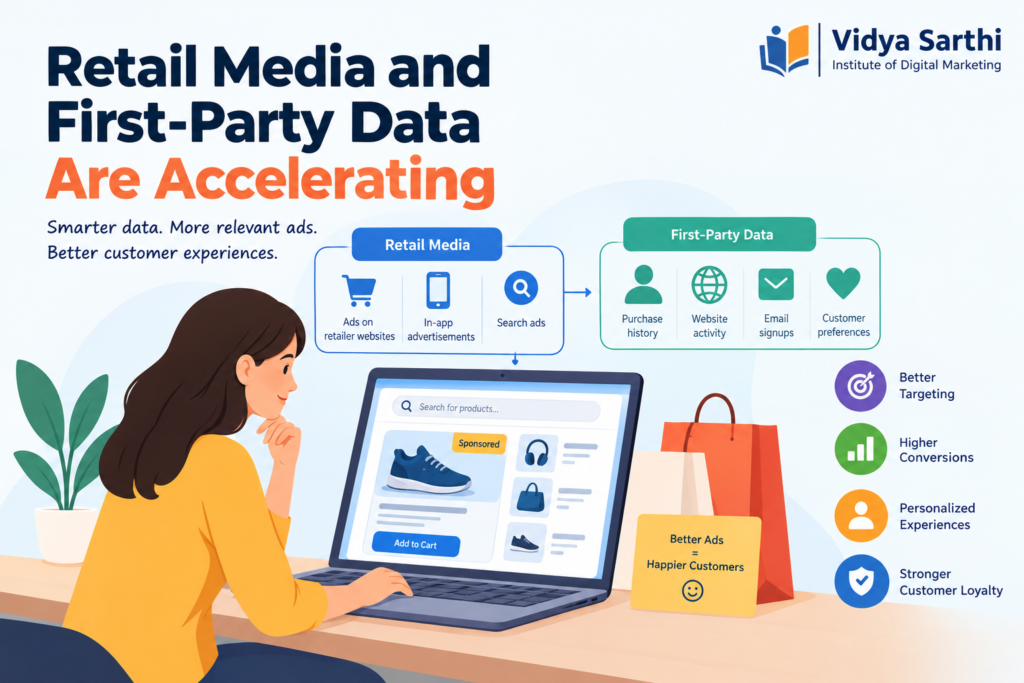
Retail media means advertising products or services through a retailer’s digital platforms. It allows brands to promote their products directly on websites, apps and other digital platforms of retailers.
For example, when a customer visits an online shopping website and searches for a product, they may see sponsored products or advertisements related to their search. These advertisements are a part of retail media.
Retail media helps brands reach customers at the time when they are already interested in buying something. This makes the advertisement more useful and relevant.
Some common examples of retail media include:
Sponsored products on shopping websites
Advertisements inside retail apps
Display ads on retailer websites
Search advertisements on e-commerce platforms
Promotions based on customer shopping behaviour
Retail media is becoming an important part of digital marketing because businesses can advertise their products closer to the point of purchase.
What is First-Party Data?
First-party data is the information that a business collects directly from its customers. This data can come from different sources such as websites, mobile apps, purchases, forms, email subscriptions and customer interactions.
For example, if a customer purchases a product from a company’s website, the company can collect information related to that purchase. If the customer signs up for an email newsletter, the business can also use that information for marketing purposes.
Some examples of first-party data are:
Customer purchase history
Website activity
Email subscriptions
Customer preferences
App activity
Product searches
Customer feedback
Loyalty programme information
First-party data is useful because it comes directly from the interaction between the customer and the business.
Why First-Party Data is Becoming Important?
The digital marketing industry is moving towards a privacy-focused environment. Customers are becoming more aware of how their data is being used. At the same time, changes in cookies and online tracking are making it harder for businesses to depend completely on third-party data.
Because of this, companies are focusing more on the data they collect directly from their customers.
First-party data helps businesses understand their customers better. It can also help them create more personalized marketing campaigns.
For example, if a customer has purchased sports shoes from a website, the business can use this information to promote sports clothing, socks or other related products to that customer.
This can make marketing more relevant and can also help improve the customer experience.
How Retail Media and First-Party Data Work Together?
Retail media and first-party data are becoming more powerful when they work together.
Retailers have a large amount of customer information because customers use their websites and apps to search, compare and purchase products. This information can help retailers understand customer behaviour.
Brands can use retail media platforms to reach customers based on this type of information.
For example, a customer searches for a laptop on an e-commerce website. The retailer can show advertisements for laptops, laptop bags, headphones or other related products. The brand can reach a customer who is already showing interest in that category.
This makes advertising more targeted compared to showing the same advertisement to everyone.
Benefits of Retail Media for Businesses
Retail media provides many benefits to brands and retailers.
1. Better Customer Targeting
Retail media helps businesses target customers based on their shopping behaviour and interests. This can make advertisements more relevant.
2. Higher Purchase Intent
When a customer is already searching for a product, they may have a higher intention to purchase. Retail media allows brands to reach customers at this important stage.
3. Better Measurement
Retail platforms can provide information about advertisements, clicks and purchases. This helps businesses understand how their marketing campaigns are performing.
4. More Personalized Marketing
First-party data helps businesses understand customer interests and preferences. Brands can use this information to create more personalized campaigns.
5. Better Customer Experience
When customers see products and offers that are relevant to them, it can improve their overall shopping experience.
The Role of Digital Marketers
As retail media and first-party data continue to grow, the role of digital marketers is also changing.
Digital marketers now need to understand not only social media, SEO and paid advertising but also customer data and privacy.
They need to know how to collect customer data properly, how to understand it and how to use it for marketing campaigns.
Digital marketers also need to focus on creating useful content and personalized experiences instead of showing the same advertisement to every customer.
This means that data analysis is becoming an important skill in digital marketing.
Retail Media is Changing Online Advertising
Traditional online advertising usually focuses on reaching a large number of people. But retail media focuses more on reaching people who are already interested in a product or category.
This is one of the reasons why retail media is becoming an important part of the digital advertising industry.
For brands, it provides a way to connect advertising with shopping behaviour. For retailers, it creates another source of revenue from their digital platforms.
This creates a situation where both retailers and brands can benefit.
Challenges of First-Party Data
Although first-party data has many benefits, businesses also need to handle it carefully.
Customers expect businesses to protect their personal information. Companies need to be transparent about how they collect and use customer data.
Businesses should also make sure that their data is accurate and properly managed.
If the data is outdated or incorrect, it can affect marketing campaigns and customer experience.
Therefore, businesses need to focus on responsible data collection and proper data management.
Future of Retail Media and First-Party Data
The future of digital marketing is becoming more focused on data, privacy and personalization.
Retail media is expected to become a bigger part of digital advertising as more brands look for effective ways to reach customers. At the same time, first-party data will become more valuable because businesses want to build direct relationships with their customers.
Businesses that understand their customers and use their data properly can create better marketing strategies.
For digital marketing students and professionals, understanding retail media and first-party data can also become an important skill for building a career in the digital marketing industry.
Conclusion
Retail media and first-party data are accelerating the growth and development of digital marketing. Retail media helps brands reach customers on shopping platforms, while first-party data helps businesses understand their customers better.
Together, they are helping businesses create more targeted, personalized and useful marketing campaigns.
Digital marketing is not only about showing advertisements anymore. It is also about understanding customers and giving them the right information at the right time.
As privacy and customer expectations continue to change, businesses that learn how to use first-party data and retail media properly can stay ahead in the digital marketing industry.
If you want to learn more about digital marketing, start learning about new trends like retail media, first-party data, SEO, social media marketing and paid advertising.
Keep learning, keep practicing and understand how digital marketing is changing with time.
Start your digital marketing learning journey today with Vidya Sarthi and build your skills for the future of digital marketing.
1. Why should digital marketing students learn about retail media?
Digital marketing students should learn about retail media because it is an important part of online advertising. Understanding retail media and first-party data can help students develop useful skills in advertising, customer analysis and digital marketing strategy.
2. How can digital marketers use first-party data?
Digital marketers can use first-party data to understand customer preferences, create personalized email campaigns, improve advertising strategies and provide relevant product recommendations. They should always respect customer privacy and applicable data protection rules.
3. How do retail media and first-party data work together?
Retail media allows brands to advertise on retail platforms, while first-party data helps retailers understand customer interests and shopping behaviour. Together, they help businesses show more relevant advertisements to potential customers.